
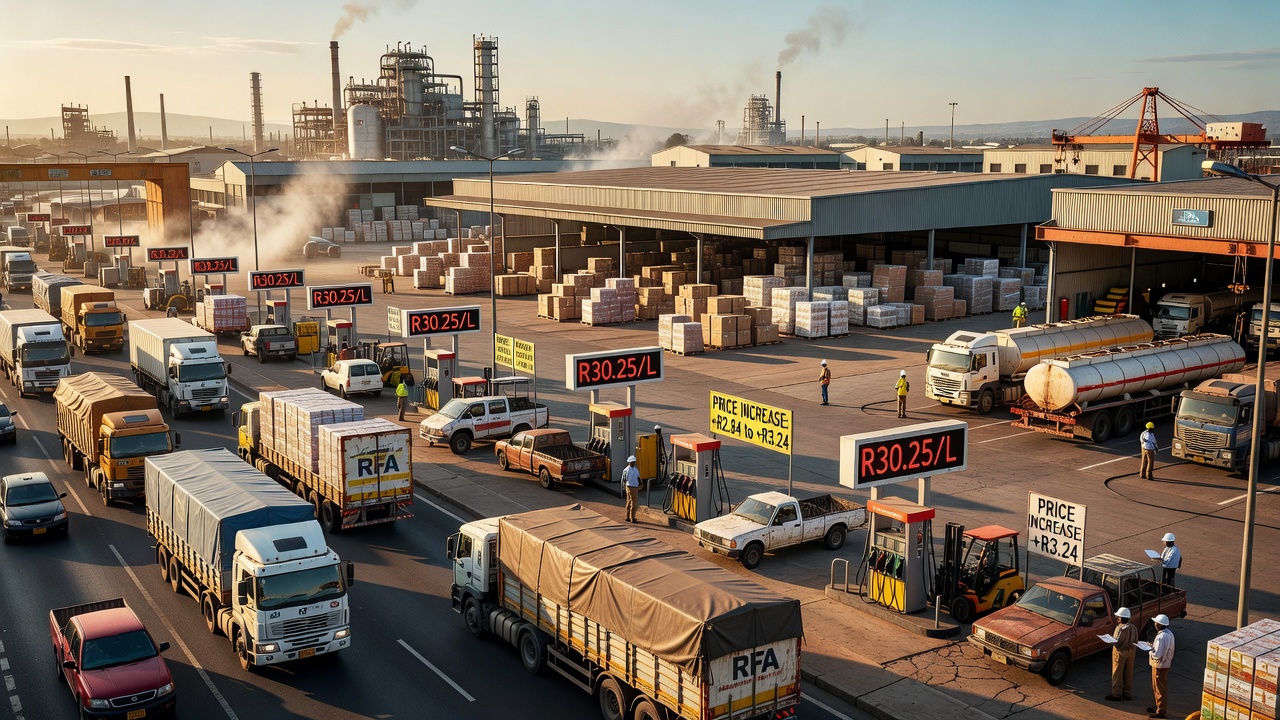
Petrol crosses the R30-a-litre threshold from midnight Wednesday, climbing to roughly R30.25, while diesel rises by between R2.84 and R3.24 a litre. The increase will not hit consumers at the till immediately, but logistics industry voices warn that the cost will work its way into the price of goods within a month.
Why shelf prices lag behind pump prices
Road Freight Association CEO Gavin Kelly explains that most goods currently being moved across the country were ordered weeks in advance and are already sitting in warehouses or loaded onto trucks under existing contracts. Retailers and distributors typically price stock based on the transport costs locked in at the time of order, not the cost of fuel on the day a truck leaves the depot. That buffer means current retail prices reflect an earlier, cheaper fuel environment. Once that stock is depleted and new orders are placed at the higher diesel price, the increase begins to show up in invoices, and eventually on shelves. Kelly estimates this transition could take around a month, though the exact timing will vary by sector and by how quickly inventory turns over.
Smaller operators absorb the shock first
Within the freight industry itself, the pain is not evenly distributed. Larger freight companies often negotiate bulk fuel purchases directly from depots, securing better rates than the pump price. Smaller operators generally lack that leverage and fill up at ordinary forecourts alongside private motorists, meaning they feel the full force of the increase from day one. Kelly cautions against assuming the big players are shielded entirely, noting that even large freight companies can find themselves financially stretched when fuel costs rise sharply, since diesel is typically their single largest operating expense after wages.
The case for domestic fuel production
Kelly also raises a structural point that goes beyond this particular price hike: South Africa's exposure to imported petroleum products leaves transport costs vulnerable to global oil price swings and currency movements largely outside the country's control. He argues for greater use of domestic coal reserves to produce synthetic fuel, pointing to Sasol's existing coal-to-liquid capability as an underused national asset. The logic is straightforward - fuel produced from local coal would not carry the same import and currency-conversion costs as crude oil bought on international markets. Whether that is commercially or environmentally viable at scale involves far more complex trade-offs than fuel policy alone, including refining capacity, carbon emissions commitments and global coal demand, but the underlying concern about import dependency is one shared widely across the logistics sector.
What it means for households
For ordinary consumers, the practical takeaway is timing rather than magnitude. Grocery bills, delivery charges and the cost of transported goods will not jump overnight, but the increase is effectively already baked into the supply chain and will surface gradually as retailers restock at the new, higher transport cost. Businesses that operate on thin margins or shorter inventory cycles are likely to pass on costs faster than those with deeper stockpiles, meaning the impact will not land uniformly across all goods or all retailers at the same time.