
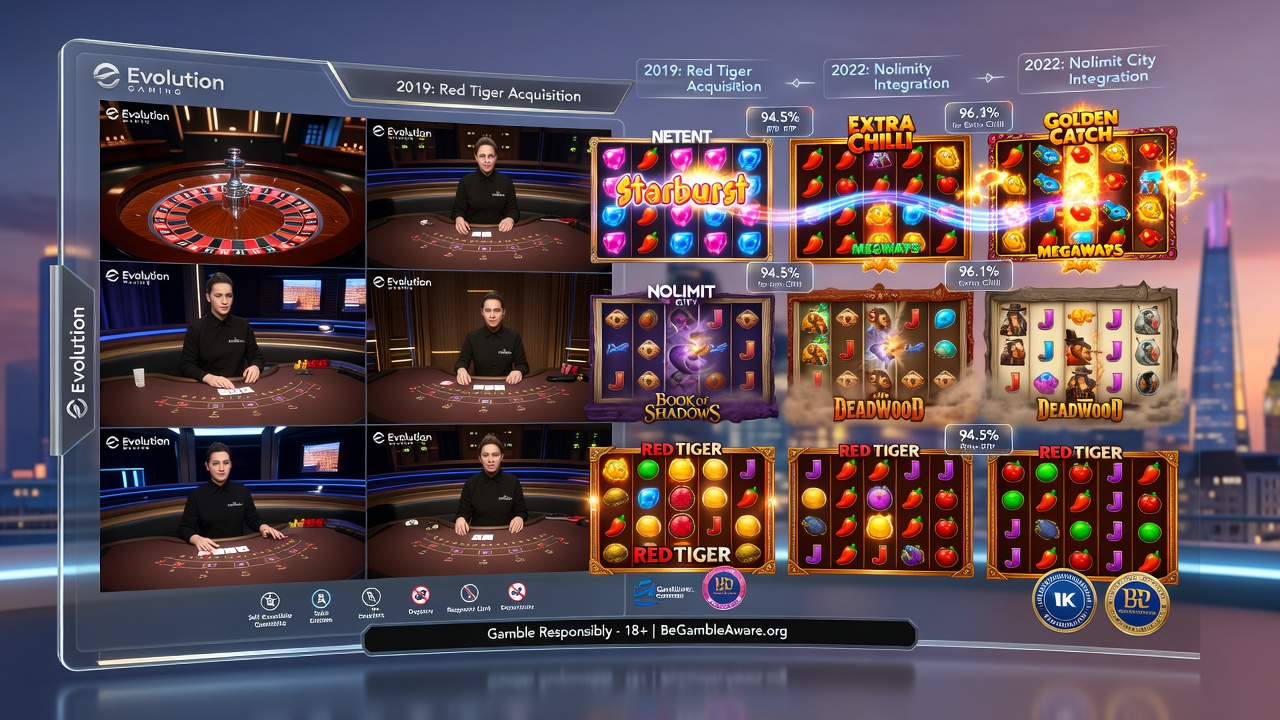
A company that built its reputation on streaming live roulette and blackjack from studio floors now controls some of the best-known names in online slots. Evolution Gaming, founded in Sweden in 2006, has spent the past several years buying up rival software houses rather than simply growing its own catalogue. The result is a single corporate group whose technology now underpins a large share of what UK players encounter on licensed casino sites.
From Live Dealers to a Slots Empire
Evolution's original business model was straightforward: replicate the casino floor experience online through real dealers, physical cards and wheels, and high-definition video streams. That approach proved durable, and live dealer games remain the segment most associated with the brand. But the company's growth strategy shifted markedly from 2019 onward, when it acquired Red Tiger. NetEnt followed in 2020, then Big Time Gaming in 2021 and Nolimit City in 2022. Each of these studios had already established its own identity among slot players - NetEnt through titles like Starburst, Big Time Gaming through its patented Megaways mechanic, Nolimit City through volatile, feature-heavy games aimed at experienced players. Rather than rebrand these studios, Evolution has kept them operating under their original names, which means many players may not realise how much of the slots market now sits under one corporate roof.
Why Consolidation Matters for Operators and Players
Consolidation in gaming software is not unique to Evolution, but the scale of its buying spree is notable. For UK-facing casinos, having a single commercial relationship that covers live dealer tables, classic slots and Megaways titles simplifies licensing and content deals. For players, it means familiar games from different studios are increasingly bundled together on the same platforms. This concentration raises a separate question worth noting: when a handful of suppliers account for a large proportion of available content, operators have less incentive to diversify, and players may see similar mechanics repackaged across many sites under different names.
What the Games Actually Offer
The subsidiary studios bring distinct mechanics rather than interchangeable products. NetEnt's Starburst relies on expanding wilds and respins with a relatively low volatility profile, while its Dead or Alive II carries much higher volatility and a steep maximum win multiplier, making it a different risk proposition entirely. Big Time Gaming's Megaways system, used in titles like Extra Chilli and Golden Catch, varies the number of ways to win on each spin. Nolimit City's games, including Book of Shadows and Deadwood, tend toward aggressive volatility and mechanics such as reel splits or nudges designed to produce rare, large payouts. Return-to-player percentages are published for each title and typically sit in the mid-90s, though RTP is a long-term theoretical average and does not predict the outcome of any single session.
Regulatory Context and Player Protection
Any operator offering Evolution-linked content to UK customers must hold a UK Gambling Commission licence, a requirement that brings obligations around responsible gambling tools, identity verification and marketing standards. Bonuses tied to these games, such as deposit matches or free spins, carry wagering requirements and terms that vary by site and should be read carefully rather than treated as straightforward value. High-volatility slots in particular can produce long losing runs between larger wins, and no game mechanic - however elaborate - changes the underlying house edge. Players are better served by treating these products as entertainment with built-in cost than by chasing patterns in game features.