
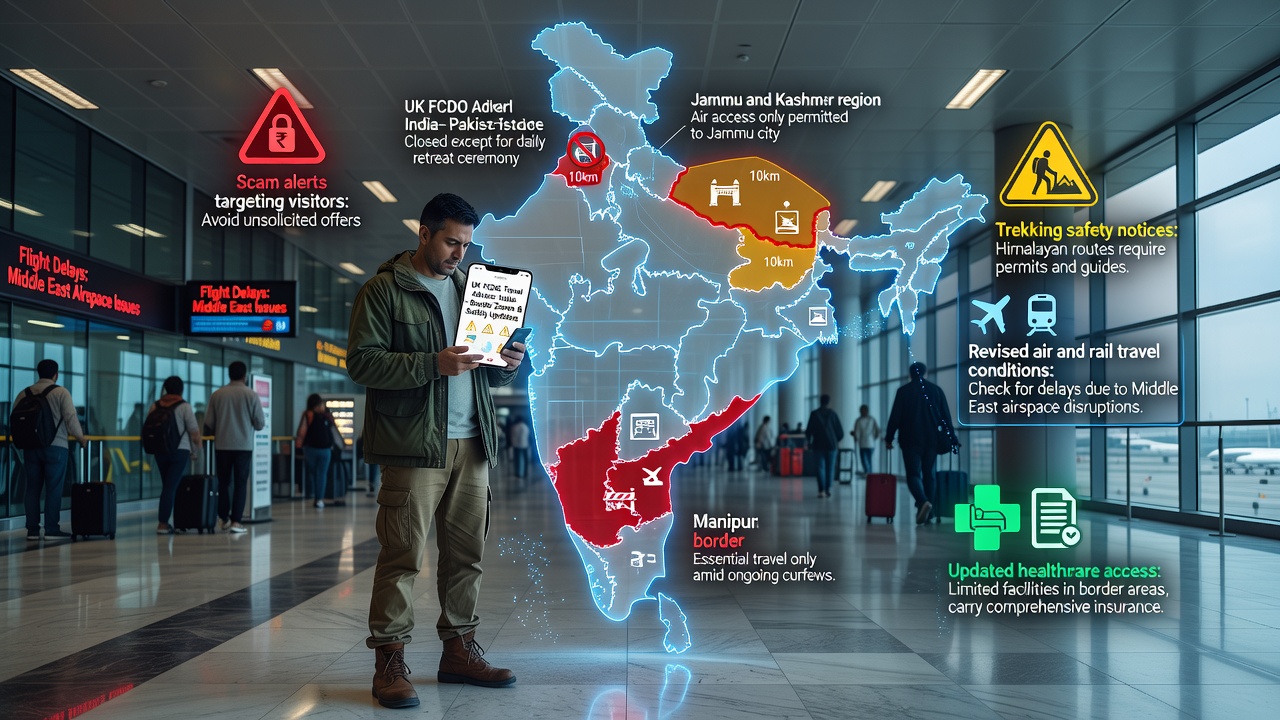
The UK Foreign, Commonwealth & Development Office (FCDO) has revised its travel advice for India, refining guidance on entry permits, regional safety risks and health precautions. The update touches three core sections of the advice - Entry requirements, Safety and security, and Health - and reflects ongoing monitoring of border tensions, localised unrest and traveller scams rather than any single new incident.
Why Border Regions Remain Off Limits
The clearest guidance concerns geography. FCDO continues to advise against all travel within 10km of the India-Pakistan border, with the Wagah-Attari crossing closed to the public except for the daily retreat ceremony that draws tourists on both sides. Jammu and Kashmir remains subject to advice against all travel, barring air travel to and from Jammu city and movement within the city itself. Manipur is flagged for essential travel only, with curfews and restrictions persisting in parts of the state amid ethnic violence that began in May 2023. These distinctions matter practically: insurance cover can be invalidated if someone travels against explicit FCDO advice, so the line between "advised against" and "essential travel only" has real financial consequences for anyone planning an itinerary.
Regional Conflict and Its Ripple Effects
Beyond South Asia itself, the advisory notes that escalation in the Middle East has produced broader disruption - airspace closures, delays and cancellations - that can affect travellers to India even when their route does not pass through the region directly. The guidance urges checking advice for any transit countries, confirming flight status with airlines or tour operators, and reviewing insurance terms before departure. Travellers whose visas are affected by disruption are directed to the nearest Foreigners Regional Registration Office, a reminder that administrative consequences can follow from events entirely outside a traveller's control.
What Changed in the Detail
The amendments themselves are incremental rather than sweeping. Updated points include:
- Clarified requirements around access permits for restricted areas
- Refreshed warnings on common scams targeting visitors
- Updated notes on trekking safety, relevant given the popularity of Himalayan routes
- Revised guidance on air and rail travel conditions
- Additional detail on the India-Pakistan border area and parts of Western India
- Updated healthcare information, including standards and access to medical treatment
None of these changes signal a shift in the overall risk assessment for most of the country. They function more as maintenance of an already detailed advisory - the kind of routine review that embassies conduct periodically rather than a response to a single triggering event.
The Broader Point About Travel Advisories
Government travel advice exists to inform decisions, not dictate them, but it carries weight insurers and tour operators take seriously. No destination can be guaranteed safe, and FCDO's own framing makes that explicit. For travellers to India, the practical takeaway is less about alarm and more about preparation: checking current guidance for specific regions, confirming insurance actually covers planned activities and locations, and treating advisories on places like Jammu and Kashmir or Manipur as binding for insurance purposes even where personal risk tolerance might differ. Subscribing to update alerts remains the simplest way to stay current as conditions shift.