
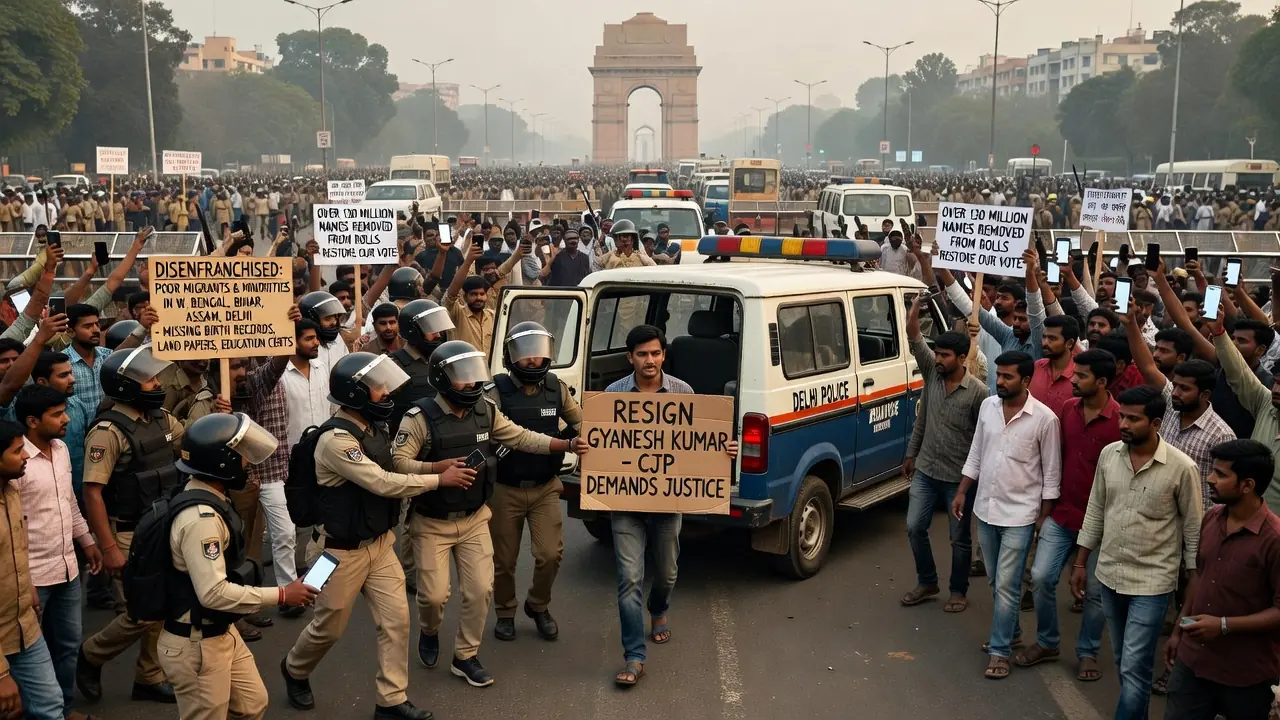
Security forces in New Delhi detained hundreds of protesters, including the founder of the satirical Cockroach Janta Party (CJP), Abhijeet Dipke, to stop a planned rally demanding the resignation of India's chief election commissioner, Gyanesh Kumar. Thousands of police were deployed, roads were sealed, and telecommunications links were suspended across parts of the capital, turning a youth-led demonstration into a nationwide flashpoint over the integrity of India's electoral system.
What is actually in dispute
At the center of the controversy is the Special Intensive Revision (SIR), a process launched to clean up India's electoral rolls by requiring voters to furnish old documentary proof of eligibility - birth records, land papers, or education certificates. Critics argue the burden falls hardest on the poor, migrants, and minority communities, groups less likely to hold decades-old paperwork in perfect order. A single clerical mismatch, even a misspelled name, can result in disenfranchisement. In India, where welfare entitlements are often linked to voter registration, losing one's place on the rolls can mean losing more than a ballot.
Opposition parties say the pattern of deletions has disproportionately affected Muslim voters in states such as West Bengal, Bihar, Assam, and Delhi, and they allege the exercise has quietly reshaped outcomes in recent state elections. More than 130 million names have reportedly been removed from the rolls since the drive began, fueling demands that the Election Commission explain its methodology or that Kumar step down.
A protest movement born from a judicial insult
The CJP's rise is itself a case study in how grievance can be organized quickly in the social-media era. The group formed in May as a satirical response to a remark by India's Chief Justice comparing unemployed youth and activists to "cockroaches." What began as online mockery evolved into a structured protest movement that, in July, successfully forced the resignation of the education minister over exam-system failures. That early win gave the movement credibility and momentum heading into its current campaign against the election commissioner.
Detentions, press access, and the shrinking space for dissent
The scale of this week's response - reports suggest more than 5,000 detentions, among them opposition leaders, student organizers, lawyers, and journalists - has drawn condemnation from Amnesty International, which accused authorities of manufacturing "a climate of fear" ahead of a lawful assembly. The Committee to Protect Journalists separately raised concerns about reporters being detained and equipment confiscated while covering the demonstrations, arguing that press access to a story of clear public interest should not be restricted by the same police operation meant to maintain order.
The government's position, articulated by BJP spokesman Sambit Patra, is that the protests represent a marginal "anarchic" disruption rather than a genuine reflection of public sentiment. Independent analysts see it differently, describing the moment as a test of institutional credibility at a time when trust in the Election Commission - an institution once regarded as a model for electoral administration - has visibly eroded.
Why this matters beyond India
Disputes over voter-roll accuracy are not unique to India, but the scale here is unmatched: no other democracy manages elections for over 1.4 billion people. How the commission responds - through transparency, judicial review, or continued silence - will shape confidence in electoral administration well beyond this single protest cycle. The Supreme Court challenge to the SIR process remains the more consequential track, since street mobilization, however large, cannot by itself reverse an administrative decision already embedded in the electoral rolls.