
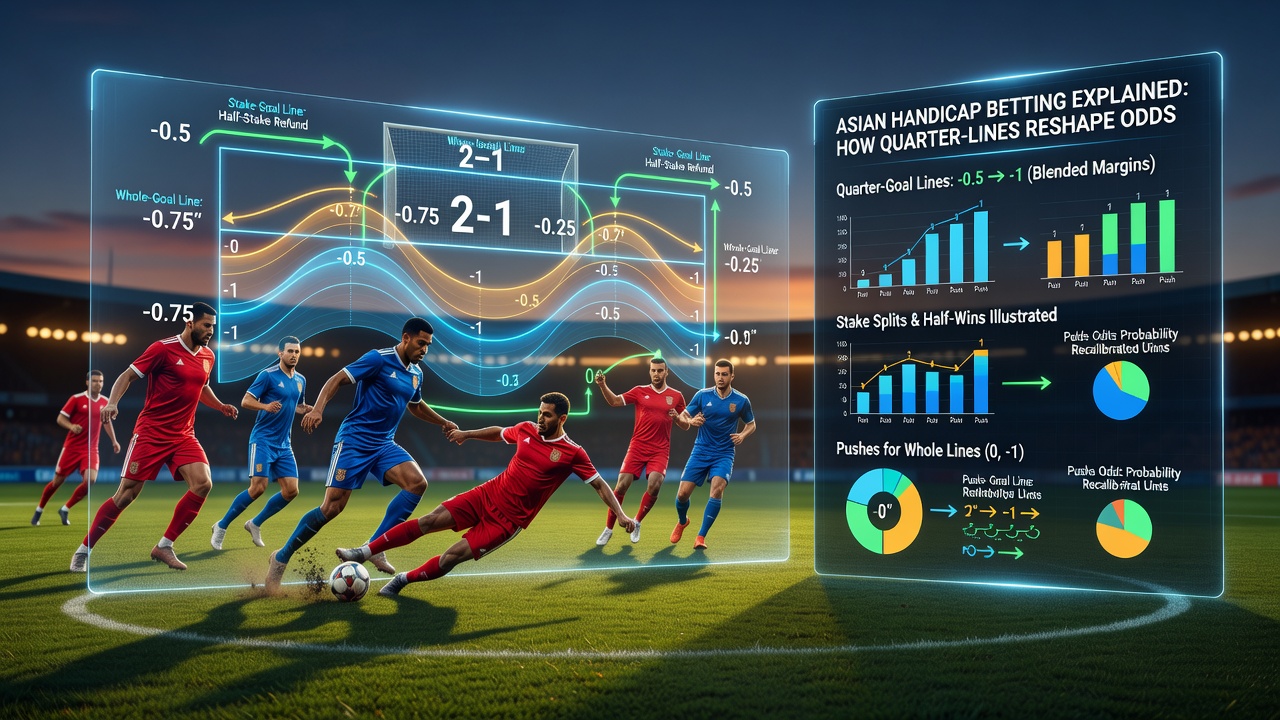
Asian Handicap betting removes the draw from football wagering by attaching a virtual goal advantage or deficit to one side before a ball is kicked. Instead of three outcomes, bettors face a binary choice - favourite or underdog - with the final score adjusted by the handicap to determine the result. The format originated in Asian bookmaking circles decades ago and has since become a mainstay on exchanges and sportsbooks worldwide, prized for tighter margins and a more granular way of pricing match outcomes than the traditional 1X2 model.
Why Quarter-Goal Lines Matter
The mechanism that separates Asian Handicap from ordinary spread betting is the quarter-goal line - figures like -0.25, -0.75 or -1.25. These aren't single bets but a blend of two adjacent whole or half lines, with the stake split evenly between them. A -0.75 handicap, for instance, is half riding on -0.5 and half on -1. Win by two or more goals and both halves pay out. Win by exactly one, and only the -0.5 portion succeeds while the -1 portion is voided, producing a partial win rather than an all-or-nothing result. This structure allows bookmakers to price markets more precisely around where goal-margin probability actually clusters, rather than forcing bettors into a coarser half-goal or whole-goal choice.
The practical effect is that outcomes which would be a flat loss or win elsewhere become partial wins, partial losses, or partial refunds under Asian Handicap. That nuance is often misunderstood by newcomers, who assume all handicap betting behaves like a simple spread. It doesn't - and the settlement mechanics genuinely change the risk profile of a bet depending on which line is selected.
AH 0 and Its Relationship to Draw No Bet
The simplest version, AH 0 or "Level Ball," applies no adjustment at all. Win and the bet wins; draw and the stake is returned; lose and the stake is lost. Functionally, this is identical to Draw No Bet. What differs is pricing. Asian Handicap markets typically carry deeper liquidity and slimmer bookmaker margins than their DNB equivalents covering the same event and settlement logic, which can mean a meaningfully better price for an outcome that settles in exactly the same way. Bettors comparing odds across formats sometimes find value simply by checking whether the AH 0 line beats the DNB line on the same match, rather than defaulting to whichever market is more familiar.
How Lines Are Priced and Why Risk Isn't Uniform
Modern handicap pricing - whether done by a bookmaker's trading desk or a bettor's own model - generally starts from an estimated probability distribution of winning margins, often built using statistical frameworks such as Dixon-Coles adjustments that weigh attack strength, defensive record, home advantage and current form. From that distribution, expected value can be tested across every available line, from 0 up to steep handicaps like -2.5 or beyond for heavily mismatched fixtures. A deeper handicap isn't automatically higher risk in value terms if the underlying model assigns a strong probability to a wide winning margin; conversely, a shallow line can carry hidden risk if the probability mass sits awkwardly around the cut-off point.
- Whole-goal lines (0, -1, -2) allow a full push if the margin matches exactly.
- Half-goal lines (-0.5, -1.5) never push - there is always a winner.
- Quarter-goal lines (-0.25, -0.75, -1.25) split the stake and can produce half-wins or half-refunds.
What This Means for Bettors
Asian Handicap rewards attention to detail rather than instinct. Understanding exactly how a stake splits, when a push occurs, and how pricing compares to equivalent markets elsewhere is more useful than chasing a line because it "feels" favourable. No handicap structure changes the fundamental uncertainty of a football match or guarantees a return - it only reshapes how that uncertainty is sliced and priced. Treat any quoted win-rate or performance figures from tipping services as historical and context-specific, not predictive. Anyone finding it difficult to keep betting within planned limits should consider the support resources available through BeGambleAware.org. Betting markets of this kind are intended only for adults aged 18 and over, and responsible bankroll management remains essential regardless of how sophisticated the pricing model behind a given line appears to be.