
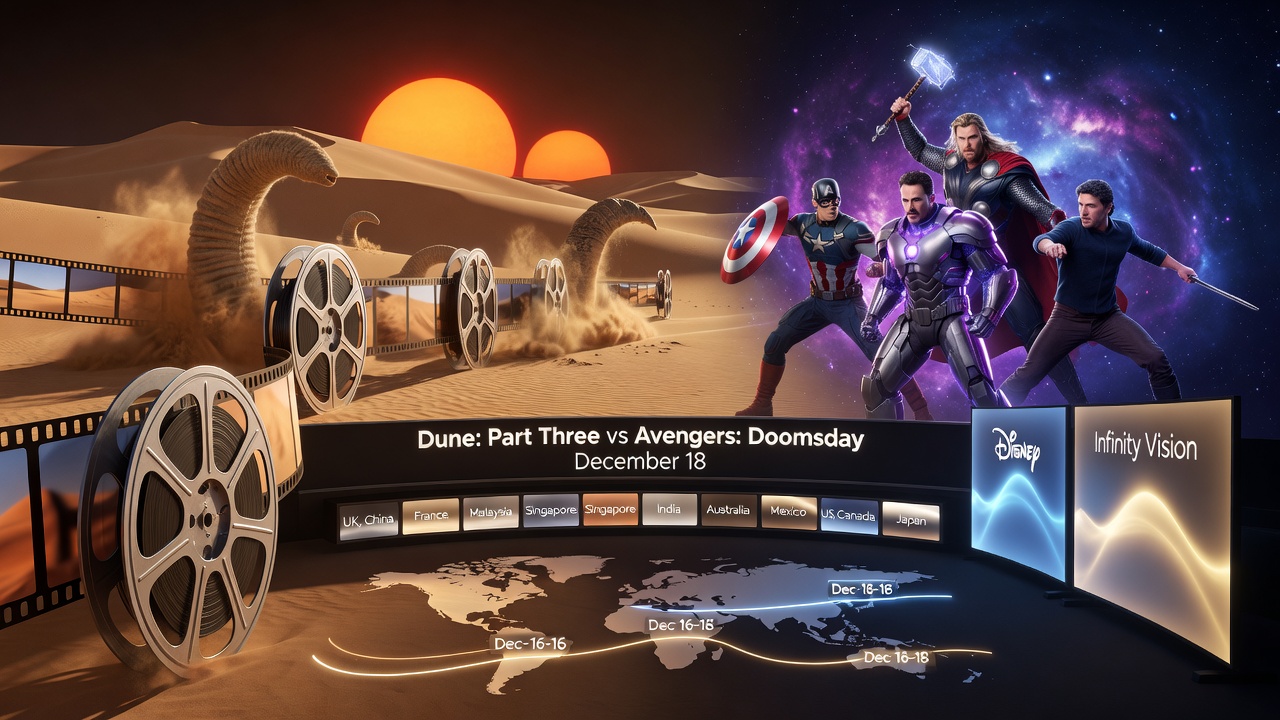
Two of the biggest release-calendar bets in modern Hollywood history land on the same date this December, and the industry is already treating it as a case study in strategic risk-taking. Warner Bros.' "Dune: Part Three" and Disney's "Avengers: Doomsday" are both set for December 18, a collision that was not accidental but the result of calculated scheduling moves by two studios confident enough in their franchises to court direct competition.
How the Scheduling Standoff Developed
The matchup traces back to June 2024, when Warner Bros. claimed December 18, 2026, for an unnamed Denis Villeneuve event film that later became "Dune: Part Three." Disney had originally slotted "Avengers: Doomsday" for May 2026, a date with far less competition. Moving it to December, directly against Villeneuve's finale, was a deliberate wager that the Marvel brand and its ensemble cast - including Robert Downey Jr. returning as Doctor Doom, alongside Chris Evans, Chris Hemsworth and Pedro Pascal - could hold its own against one of the most acclaimed science-fiction franchises in recent memory. The international release pattern adds further nuance: "Avengers: Doomsday" opens in the UK, China, France, Malaysia and Singapore on December 16, followed by India, Australia and Mexico on December 17, before reaching the US, Canada and Japan on December 18. Staggered rollouts like this are standard practice for tentpole releases, allowing studios to manage print distribution, marketing cycles and piracy exposure across time zones, but the proximity of these dates to "Dune" underscores how tightly both campaigns are being managed.
The IMAX Fight Behind the Marketing
The more consequential battle may not be in theaters' general-admission screens but in premium large-format access. Reports indicate "Dune: Part Three" has locked in exclusive IMAX screenings for its first three weekends, a period that typically accounts for a disproportionate share of a blockbuster's total box office. That exclusivity shuts "Avengers: Doomsday" out of the format during the exact window when audience momentum and word-of-mouth are built. Warner Bros. is leaning into this advantage, promoting IMAX 70mm presentations and over an hour of expanded aspect-ratio footage, a technical distinction that matters to a segment of moviegoers willing to pay a premium for the largest possible image and the most immersive sound mix available.
Disney's Countermove: A New Premium Format
Locked out of IMAX during the critical launch period, Disney has responded by creating Infinity Vision, a new certification standard for premium large-format screens covering screen size, brightness and sound quality. This is less a technological leap than a competitive necessity - a way to offer exhibitors and audiences a comparable premium experience without relying on a format controlled by a rival's deal. The move illustrates how exhibition technology has become a genuine battleground in blockbuster marketing, not just a backdrop. Screen format, release timing and international sequencing are no longer secondary logistics; they are core strategic levers studios use to shape opening-weekend performance and long-term box office trajectories.
Why This Standoff Matters Beyond the Films
For the broader entertainment economy, this clash is a signal of how concentrated risk has become in theatrical releasing. Studios increasingly treat single weekends as zero-sum contests, and the infrastructure fight over IMAX access shows how exhibition partnerships can be as decisive as star power or franchise loyalty. Audiences, meanwhile, are left choosing not just which film to see, but which technical format delivers the experience worth leaving home for - a dynamic that will likely shape how future tentpoles negotiate their own release windows.