
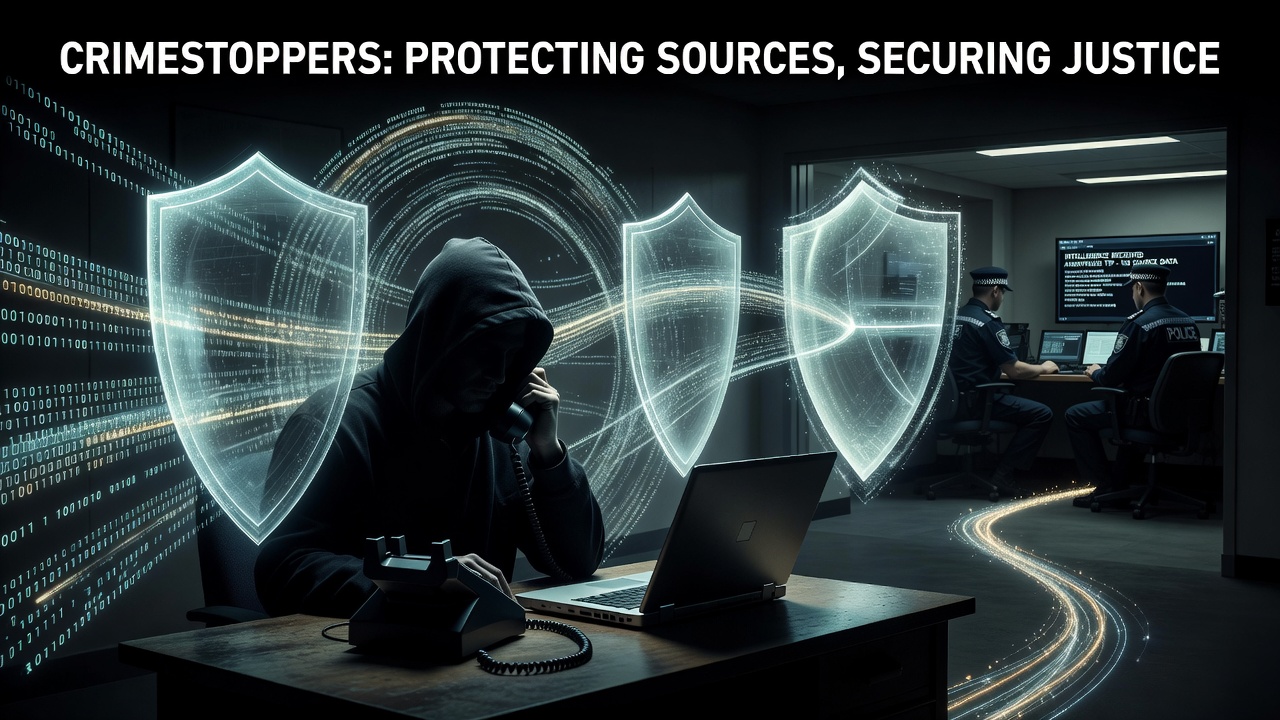
Crimestoppers has built its entire model on a single promise: the person passing on information will never be identified. No names are taken, no IP addresses are logged, and calls or online submissions cannot be traced back to an individual. That promise is not a marketing line - it is the operational foundation that allows the charity to function as an independent intermediary between the public and law enforcement.
Why anonymity is the whole point
Crimestoppers is not a police service. It is an independent charity, and that distinction matters. Because it sits outside the formal justice system, it can offer a layer of separation that a direct police report cannot. People who might otherwise stay silent - out of fear of retaliation, workplace consequences, or simply discomfort with formal statements - are more likely to come forward when they know their identity cannot surface later, even in court proceedings. Technical anonymity is paired with organisational independence, and the two reinforce each other: even if someone wanted to identify a source, the data to do so simply is not retained.
Information judged useful may be forwarded to partner organisations, but only where doing so supports public or workplace safety. This is a narrow, purpose-limited form of data sharing, not a general handover of case files, and it reflects a broader principle now common across data protection frameworks: information collected for one protective purpose should not circulate freely beyond it.
Financial incentives, kept in proportion
Cash rewards, up to £1,000, are available where a tip leads to an arrest or proves significantly useful. This is a modest, capped incentive structure, not a payment-for-information marketplace. It exists to encourage disclosure, not to create a financial motive strong enough to distort what people report. The reward sits alongside anonymity as a secondary mechanism - useful, but not the primary reason the service works.
Where the service stops - and why that boundary matters
An anonymous charity cannot, and should not, replace emergency services or statutory bodies. Crimestoppers is explicit about the limits of what it can process, and those limits reveal something important about how the wider reporting ecosystem in the UK is structured:
- Emergencies require 999; non-emergency police contact goes through 101.
- Victims of crime cannot report through an anonymous channel by design - anonymity is incompatible with taking a victim's direct statement - so victims are directed to the police or to Victim Support.
- Benefit fraud, scam calls and emails, untaxed vehicles, minor driving offences, dumped vehicles, noise complaints and routine fly-tipping each have their own statutory body: the DWP, Action Fraud, the DVLA, the police directly, or local authorities.
- Missing persons cases are only handled where criminal involvement is suspected and a police appeal exists; otherwise, the charity Missing People is the correct route.
This division of labour is not bureaucratic friction. It reflects the fact that different problems require different legal powers, evidentiary standards, and accountability structures. A speeding offence needs sworn witness testimony a police officer can act on; large-scale illegal dumping or hazardous waste, by contrast, can still be reported anonymously because it sits closer to the organised, community-harm territory Crimestoppers exists to address.
The broader lesson in consumer trust
What makes this model instructive beyond its immediate purpose is how deliberately it separates trust-building mechanics from operational scope. Anonymity is engineered technically, not just promised verbally. Independence from the police is stated plainly rather than implied. And the service is honest about what it cannot do, redirecting people rather than absorbing reports it has no authority to act on. In an environment where consumers are increasingly wary of how personal data is collected, stored, and shared, that combination of technical privacy guarantees and clearly bounded institutional scope is a template worth noting, whatever sector is asking for someone's trust.